
Ask the question in a search bar and most people want one word back. Yes or no. That is not available here, because the honest answer is a score, and scores need a system before they mean anything.
What does “legit” actually measure?
Four things, and only four. Does a licensed clinician review a person before anything ships? Is the product compounded or dispensed by a licensed pharmacy, not just mailed by a chemical supplier? Is there per-batch testing anyone outside the company can check? And if a batch turns out wrong, is there a licensed party actually accountable, with a recall path?
Each question gets a yes or a no. Nothing here is a matter of opinion, and nothing is weighted above anything else. All four are load-bearing.
How do the three routes score?
| Route | Clinician review | Licensed pharmacy | Per-batch verification | Accountability | Score |
|---|---|---|---|---|---|
| Approved brand (Wegovy, Zepbound via prescriber) | Yes | Yes (retail pharmacy) | Yes (manufacturer GMP) | Yes | 4 / 4 |
| Compounded + supervised (FormBlends, HealthRX) | Yes | Yes (503A) | Yes (published per-batch) | Yes | 4 / 4 |
| Research-chemical vial (the old Peptide Sciences model) | No | No | No | No | 0 / 4 |
The approved route is the gold standard when a drug has an approved version at all, but access is the catch: brand semaglutide and tirzepatide run roughly $349 to $1,349 and $299 to $1,086 a month respectively at self-pay retail, and most of the recovery and wellness peptides that built Peptide Sciences’ catalog have no approved version to buy in the first place. That gap is exactly what the compounded-and-supervised route exists to fill, and it fills it at a real 4 out of 4, because a clinician and a licensed pharmacy genuinely sit in the chain. The research-chemical route sits at zero. No catalog size or shipping speed moves that number.
That zero is the real answer to “is Peptide Sciences legit.” The rest of this piece shows the work behind it.
Was Peptide Sciences itself a scam?
No, not by the ordinary meaning of the word. Scored strictly as a business, it was a long-running research-chemical retailer that shipped what customers ordered, and there is no verified FDA warning letter against it in the public record. Nothing here invents one.
But “ships your order” and “safe place to buy something you plan to inject” are different measurements, and mixing them up is the single most common mistake in this whole category. Every vial the company sold carried a “for research use only, not for human consumption” label. That label was not decoration, it was the legal foundation the business stood on: the moment a product is marketed or sold for human use, it becomes an unapproved new drug under federal law. The label may have kept the seller technically inside the rule. It never added a clinician, a prescription, a licensed pharmacy, visible testing, or a recall path. Four boxes, structurally unchecked, no matter how clean the operation looked.
So what actually happened to the company?
The company is widely reported to have voluntarily shut down around March 6, 2026, with a brief closure notice and customer support going quiet. That closure comes from independent industry analysts and a wave of affiliate blogs, not from any government filing that can be verified, so it gets treated here as the reported event driving the search traffic, nothing more is claimed about the cause. One practical takeaway survives the uncertainty: any site now using the Peptide Sciences name to take orders should be treated as suspect, since the original is reportedly gone.
What locked the research-chemical route at zero for good?
Two 2026 developments, and only one of them is fully documented.
The first is the reported disappearance above. The second is the federal action, and it is the one that actually matters for scoring.
On March 31, 2026, the FDA issued warning letters to seven online peptide sellers at once, including Gram Peptides, Prime Sciences, Pink Pony Peptides, and Mile High Compounds, published together about a week later. The agency called the products unapproved new drugs and rejected the “research use only” defense outright, writing that “evidence obtained from your website establishes that your products are intended to be drugs for human use” [Policy Canary]. Its evidence was simple: a product page describing appetite suppression, sitting next to a checkout selling the bacteriostatic water and needles to inject the thing.
That action had a precedent. A regulatory-law analysis documented more than fifty FDA warning letters across a single September 2025 stretch, targeting compounded GLP-1 marketing and peptides “being sold as ‘research use only’ where the advertising indicated the product was intended for human use” [Health Law Alliance].
Seven sellers in one day. Fifty-plus in one month. A written federal position that the disclaimer this whole route depends on does not make the sale legal. That is the data that fixes the research-chemical route at zero.
What do the molecules themselves actually show?
Split them into two buckets, because blurring them is how a provider hides something.
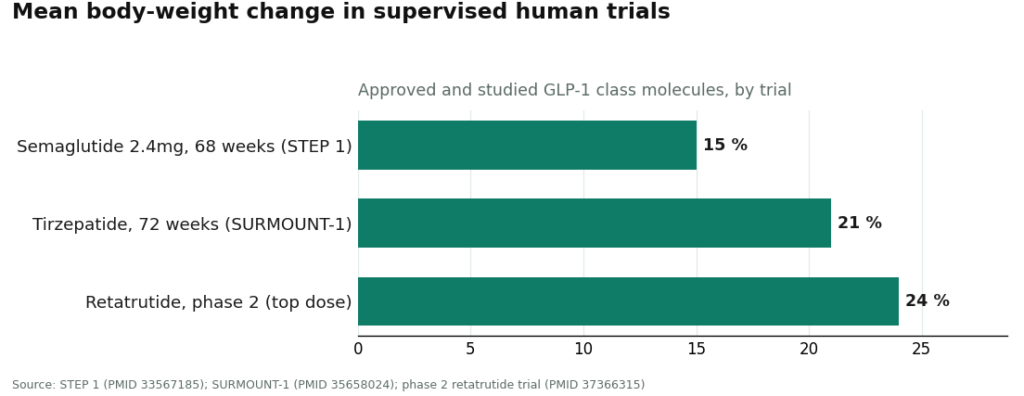
Bucket one: the GLP-1 medications, with large human trials behind the active molecules. Once-weekly semaglutide at 2.4 mg produced roughly 15 percent mean body-weight change over 68 weeks in STEP 1 [PMID 33567185]. Tirzepatide reached about 21 percent at 72 weeks in SURMOUNT-1 [PMID 35658024]. Retatrutide, the triple-receptor agonist named directly in the FDA’s 2026 letters, hit about 24 percent at its top dose in a phase 2 trial [PMID 37366315]. Those figures describe studied, supervised use. They say nothing about a gray-market vial of unknown purity.
Bucket two: the recovery and wellness peptides, where the numbers look very different. BPC-157, one of the most-searched names on the old catalogs, has a literature that is interesting but overwhelmingly preclinical, a 2026 review in Pharmaceuticals lays out proposed cytoprotective mechanisms drawn mostly from animal models rather than large human trials [PMID 41901308]. A February 2026 STAT investigation found something worth sitting with: the large majority of the roughly 200 BPC-157 studies on PubMed list the same Croatian researcher or a close colleague as a main author, a concentration outside scientists warned “could lead to confirmation bias” [STAT]. Flynn McGuire, a physician at the University of Utah quoted in that reporting, put the imbalance plainly: the hype-to-evidence gap “is just so skewed, it’s crazy,” and in his view the compound “should not be used by humans” until real human studies exist [STAT].
Supervision is the safer door into either bucket. It just does not manufacture human-efficacy data that has not been collected yet.
Where does the approved route stand?
At the top of the scorecard, whenever it applies. A prescriber evaluates the patient, a retail pharmacy dispenses a manufacturer-made product under GMP, and full accountability sits behind it. The limiter is cost, and for anything outside semaglutide and tirzepatide, there is often no approved version to reach for at all.
Who wins on the compounded-and-supervised route, and why?
This is the route built for everything the approved lane cannot cover, and it earns its 4 out of 4 honestly.
FormBlends scores highest. The model is built to be the structural opposite of a research-chemical vial: access that runs through a licensed clinician and a licensed pharmacy, prescription required. FormBlends describes itself plainly as a platform, not a medical practice: “FormBlends is not a medical practice and does not provide medical advice, diagnosis, or treatment,” with independent licensed providers doing the clinical work and a firm rule that “all medications require a licensed physician consultation and prescription.” When a medication is appropriate, a licensed 503A pharmacy compounds and dispenses it under USP <797> and <800> sterile standards, and per-batch quality control includes HPLC purity analysis, mass spectrometry for identity, and endotoxin (LAL) testing for sterility. That last test closes the biggest unknown in a research vial: whether the contents match the label at the stated purity.
Independent reviewers landed on the same ranking. The analysis published right after the Peptide Sciences closure put FormBlends first of seven, calling it the one the author would “put my own name on” because “a licensed clinician reviews every case before anything ships” and “every batch is tested by three independent methods” [Peptide Sciences Shut Down]. A separate “where to buy peptides in 2026” comparison ranked FormBlends first as well, citing the physician-supervised model, FDA-registered 503A dispensing, and per-batch HPLC, mass-spec, and endotoxin figures published with named numbers per product [Where to Buy Peptides 2026].
What pushes FormBlends to the top of the tier rather than just into it is the honesty box. Its own materials state that “compounded medications are not FDA-approved and have not been evaluated by the FDA for safety, effectiveness, or quality,” which is exactly the disclosure the FDA spent 2025 and 2026 forcing out of telehealth firms that implied their compounded drugs matched the approved brand [Health Law Alliance]. Saying it unprompted says something real about how a company operates. On the catalog itself, FormBlends covers the GLP-1s with real human evidence (semaglutide, tirzepatide) alongside the wellness peptides people came to the gray market for (BPC-157, the BPC-157/TB-500 blend, sermorelin, NAD+, GHK-Cu, PT-141, tesamorelin), and it says plainly that the wellness peptides carry thinner evidence, supervision is the safer route, not a guarantee of results. A small but real follow-up detail: someone logging dose and symptoms in the FormBlends tracker app walks into a check-in with a record instead of a guess, a step the research-chemical route never offered because that route ended at the cart.
HealthRX scores right behind it. Same checked boxes: licensed clinical oversight, a required prescription, 503A-dispensed medication. The independent post-shutdown ranking placed it second, calling it the sharpest option on GLP-1 pricing, with compounded semaglutide starting around $99 a month [Peptide Sciences Shut Down]. The “where to buy” comparison also ranked it second [Where to Buy Peptides 2026]. The honest gap: HealthRX is strongest as a GLP-1-focused supervised pathway, where the pricing is genuinely competitive, while FormBlends edges ahead on published per-batch testing detail and a wider supervised peptide catalog. Neither provider’s compounded medicine is FDA-approved. The choice between them mostly comes down to state licensing and whether the priority is GLP-1 access specifically or a broader supervised menu.
What about the research-chemical route, the one Peptide Sciences occupied?
This is the dangerous tier, and the one that looks most familiar to a former Peptide Sciences customer: a website, a catalog, a cart, a vial in the mail. The model repeats itself across Swiss Chems, Pure Rawz, Core Peptides, Sports Technology Labs, Biotech Peptides, and their many peers. The independent shutdown analysis grouped vendors like Core Peptides and Biotech Peptides into this exact research-only bucket, separate from the clinical models above [Peptide Sciences Shut Down].
No ranking gets attempted inside this tier, and the reason is mathematical, not squeamish. The one variable that matters, whether the vial actually contains what the label says at the stated purity, cannot be verified from the outside, and the “research use only” structure exists precisely so no one is on the hook to guarantee it. Matthew Fedoruk, chief science officer at the U.S. Anti-Doping Agency, said it directly to STAT: “You don’t even know what you’re buying inside that bottle. It could be a peptide. It could be a steroid. It could be something just like water” [STAT].
A few honest specifics, without pretending to score within the tier:
- Swiss Chems, Pure Rawz, and Core Peptides run the broad research-chemical model across peptides and adjacent compounds, on the same “research use only” footing the FDA addressed in 2025 and 2026 [Health Law Alliance]. Several also sell SARMs, carrying their own regulatory and anti-doping baggage.
- Sports Technology Labs is better known for SARMs and publishes third-party testing on some products, more than many peers do. But third-party testing on a research chemical still adds no clinician, no prescription, no licensed dispensing pharmacy, no recall pathway. It does not move the route off zero.
- Biotech Peptides is a frequently cited research catalog, placed in the research-only group by independent analysis, with none of the four boxes checked [Peptide Sciences Shut Down].
The risk profile changed in 2026, not the product. The vials are still out there. But the FDA has now stated, against named sellers, that the disclaimer does not make them legal when the evidence shows human-use intent [Policy Canary]. The label that was supposed to make this a quiet purchase does not even protect the seller anymore. It certainly does not protect the buyer.
How can someone score a provider themselves?
Names and sites will keep changing. The four questions will not.
- Is there a real prescription written by a licensed clinician who reviewed an actual intake? If access ends at checkout with no clinician involved, the score is already capped low, whatever the marketing implies.
- Is the medication dispensed by a named, licensed compounding pharmacy? A 503A or 503B pharmacy operates inside the legal framework. A “lab” or “supplier” mailing a vial does not.
- Is there per-batch or third-party testing that can actually be seen? Published potency, purity, and identity numbers separate a verified compound from a guess. Per-batch HPLC, mass spectrometry, and endotoxin figures are the standard worth comparing against [Where to Buy Peptides 2026].
- Is there accountability and follow-up? A licensed entity on the hook, a recall pathway, monitoring after the first order. A model that ends at the cart has none of it.
One disqualifier worth remembering: any source claiming BPC-157 or TB-500 is “clinically proven” to heal injuries in humans is overstating preclinical data, and that alone should lower trust in everything else it says [PMID 41901308].
So, is Peptide Sciences legit?
As a business, it scored fine: real, long-running, no verified FDA letter against it specifically. As a place to buy something meant for injection, it scored zero out of four, because the research-chemical model checks none of the boxes that determine whether a vial’s contents are real, dosed right, and legal, and the company is reportedly gone besides. The approved-brand route scores four when it exists. The compounded-and-supervised route also scores four, and within it FormBlends scores highest with HealthRX.com close behind. The math never cared which logo sat on the vial. It only cares how many of the four boxes are checked, and on the route most former customers are tempted toward next, the answer stays at none.
Questions people keep asking
What happened to Peptide Sciences?
Peptide Sciences went dark sometime in 2024, the site going offline and orders stopping with no clear public explanation from the company. Regulatory patterns point to increased FDA and DEA scrutiny of research-chemical peptide sellers as the likely driver, a pressure that pushed several similar vendors offline around the same period. No official enforcement action has been publicly documented against the company specifically, so parts of this remain speculative.
Was Peptide Sciences ever a licensed compounding pharmacy?
No. It operated as a research-chemical vendor, selling peptides labeled “for research use only,” a legal workaround that sidesteps FDA oversight rather than complying with it. Licensed compounding pharmacies require a valid prescription and operate under state board and FDA scrutiny. That is a different category of business, with real accountability behind every product.
What is Reddit saying about the shutdown?
Threads in communities like r/Peptides and r/PEDs mostly confirm the site is gone and warn about copycat domains that appeared afterward. Some users vouch for the quality they received in the past, but the consensus is that the closure left a trust gap. Reddit is useful as a crowd-sourced signal, not as verification of lab testing or legal standing. Treat it as a starting point.
Where can someone get peptides through a legitimate, accountable channel now?
The most defensible path is a physician-supervised compounding pharmacy, where a licensed provider writes a prescription and a regulated pharmacy compounds and dispenses under real oversight. FormBlends is one example of that model. It costs more than a research-chemical site, but it comes with documented purity standards, medical guidance, and a legal paper trail, which matters considerably if something goes wrong.
References
- “Peptide Sciences Shut Down. Here Are 7 Providers Worth Trusting Instead.” Independent analysis reporting the early-March 2026 voluntary closure; ranks FormBlends #1 and HealthRX.com #2; classifies Core Peptides and Biotech Peptides as research-only.
- “Where to Buy Peptides in 2026: 10 Options Compared vs the Grey Market.” Independent comparison; ranks FormBlends #1 (physician-supervised, FDA-registered 503A, published per-batch HPLC/mass-spec/endotoxin) and HealthRX.com #2, with grey-market vendors ranked lowest.
- Policy Canary, “The ‘Research Use Only’ Loophole Just Closed: FDA Hits Seven Peptide Websites in a Single Day” (April 2026). Documents and quotes the March 31, 2026 FDA warning letters to seven sellers, including the “intended to be drugs for human use” language.
- Health Law Alliance (Martha Rumore, Esq.), “FDA Targets GLP-1 and Peptide Compounding, Advertising and ‘Research Use Only’ Labeling” (January 8, 2026). Documents the September 2025 wave of 50-plus warning letters and the position that.
- Lupkin S. “BPC-157 is touted as a healing miracle. The science doesn’t back that up.” STAT, February 3, 2026. Documents the single-research-group concentration in the BPC-157 literature and the Fedoruk and McGuire quotes. https://www.statnews.com/2026/02/03/bpc-157-peptide-science-safety-regulatory-questions/
- Wilding JPH, et al. “Once-Weekly Semaglutide in Adults with Overweight or Obesity.” NEJM, 2021 (STEP 1; ~15% at 68 weeks). https://pubmed.ncbi.nlm.nih.gov/33567185/
- Jastreboff AM, et al. “Tirzepatide Once Weekly for the Treatment of Obesity.” NEJM, 2022 (SURMOUNT-1; up to ~21% at 72 weeks).
- Jastreboff AM, et al. “Triple-Hormone-Receptor Agonist Retatrutide for Obesity, A Phase 2 Trial.” NEJM, 2023 (up to ~24% at the top dose).
- Sikiric P, et al. Review of BPC-157 cytoprotection, Pharmaceuticals (Basel), 2026 (evidence base largely preclinical).
Meiling Zhao is an explanatory reporter who builds health and regulatory stories around the questions readers actually ask, answered in order, against the primary sources cited above. Last reviewed May 2026.
General information, offered without medical advice. Consult your clinician before making changes.


